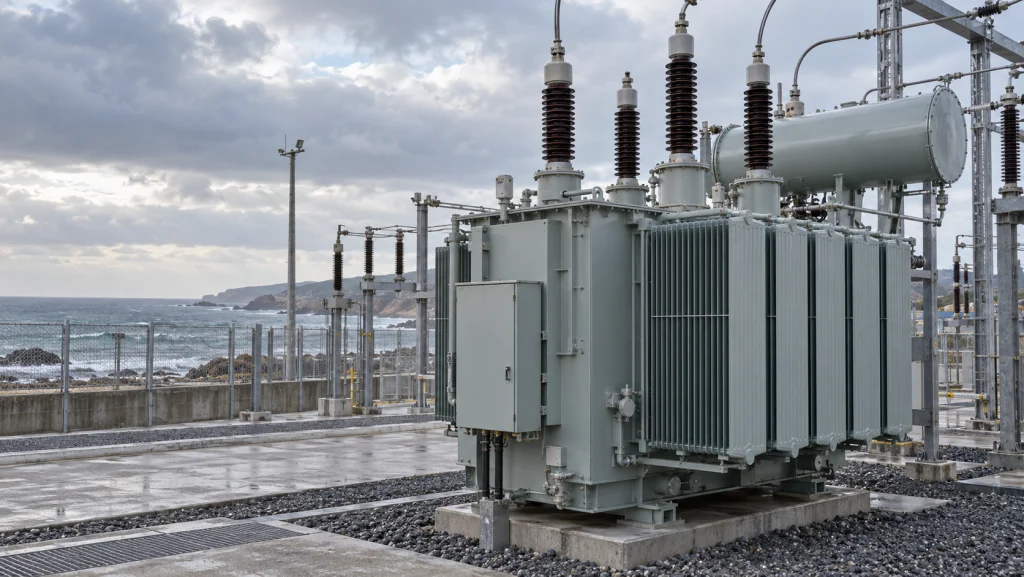
A coastal location alone cannot tell an EPC contractor which finish or exposed bushing to specify. Fast input checklist: owner and utility requirements; assessed salt and industrial exposure; outdoor arrangement; rated power and voltages; load and ambient conditions; altitude; transport limits; and any site pollution assessment. I separate protection of exposed metal from selection of external insulation before reviewing a proposed oil-immersed transformer configuration. 1234
Which site inputs govern coastal specifications?
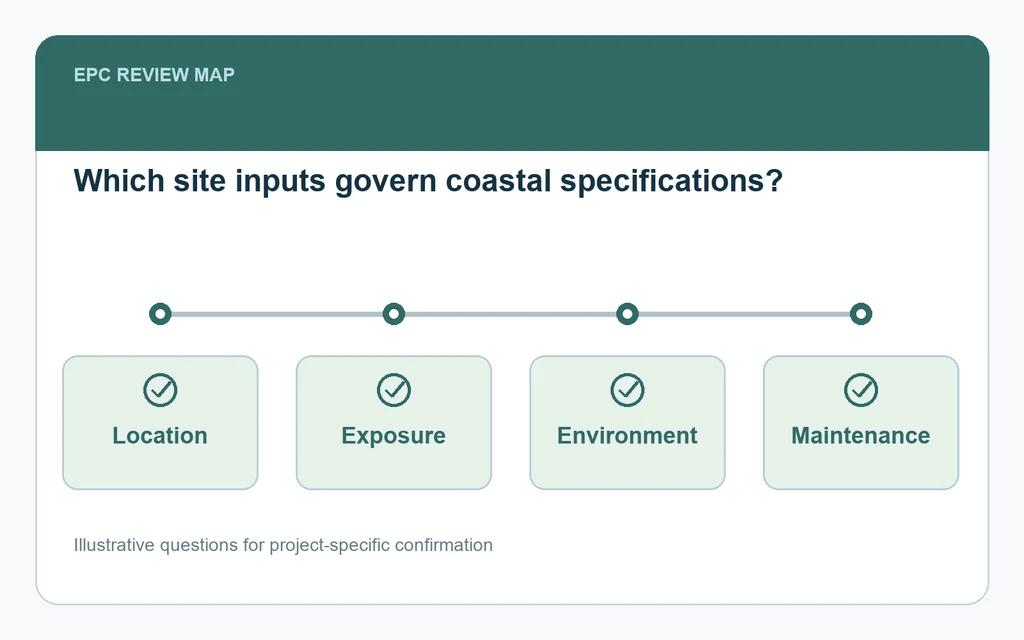
Start the coastal RFQ with the owner and utility requirements, assessed exposure, outdoor arrangement, electrical duty, ambient temperature, altitude and transport limits. Set exposed-metal corrosion and external-insulation pollution as separate requirements before confirming the transformer configuration against the site brief. 12345
Ask the project engineer for the owner and utility specifications and any assessment of salt exposure, industrial contamination and site pollution. State whether the transformer will operate outdoors without a shelter. Salt fog and airborne dust affect exposed insulation, while the atmospheric corrosion assessment governs protection of exposed metal. A distance from the shore does not settle either requirement.
I start with rated power, voltage ratio, frequency, vector group, impedance, load duty and the installation arrangement because they determine which proposals can be compared. Add the ambient temperature, altitude and transport constraints to the RFQ. Mark any missing site assessment as open rather than assigning a coastal category by assumption.
For the proposed unit, confirm whether the required cooling is ONAN, ONAF or dual-rated, and whether the tank is hermetically sealed or uses a conservator. Identify the oil and which protection accessories the design needs: Buchholz relay, oil and winding temperature indicators, pressure relief device and breather. The coastal transformer application page sets out related environmental inputs. Before ordering, check the offered drawing, cooling designation and accessory list against the site brief. 12345
How is atmospheric corrosion protection specified?
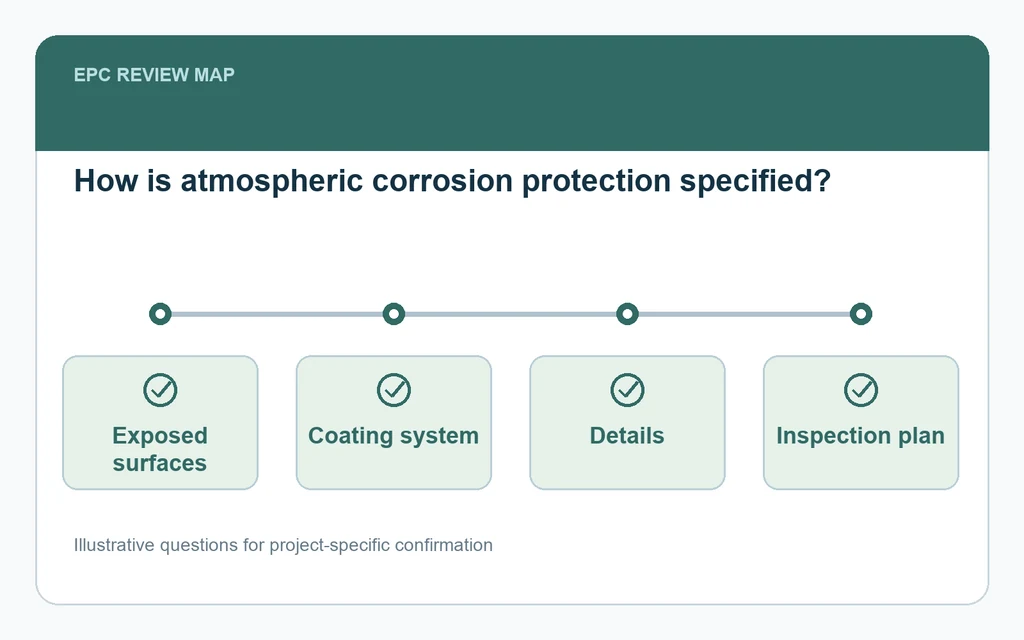
Specify atmospheric corrosion protection from the assessed site exposure and the edition adopted by the project. Name every exposed component and its proposed material and finish; a category on the tank alone leaves radiators, hardware and interfaces unresolved. Check the component schedule against the offered drawing. 156789
ISO 12944-2:2017 addresses classification of environments and their corrosivity for steel structures. Use the owner's exposure assessment and specification to establish the corrosion category and governing edition for this RFQ. An IOGP/JIP33 procurement specification requires C5 for onshore locations and CX for offshore locations within its own scope. Eaton's specification for 25–5000 kVA oil-immersed distribution transformers describes C3 for low-salinity coastal areas, C4 for moderate-salinity coastal and industrial areas, and C5 (I+M) for high-salinity coastal and offshore areas. Neither document assigns a category to your site; check the adopted terminology and edition before carrying a label into the contract.
Turn the agreed requirement into a schedule for the tank, radiators or other cooling surfaces, external fasteners and hardware, and applicable terminal or accessory interfaces. For each part, request its base material, surface preparation, protection method and finish. Where a coating is proposed, request the system, number of coats, specified dry-film thickness and tolerances, together with the applicable inspection method. Leave values open until the owner requirement and proposed system establish them.
Utility specifications show why the schedule matters: one calls for hot-dip galvanized radiators and detailed coating disclosures; another specifies corrosion-resistant external hardware and tank-coating performance checks. These are examples of contract requirements, not standard treatments for every coastal transformer. The oil-immersed transformer range is the relevant product reference, but the offer must identify the actual assembly. Before ordering, compare its component schedule with the offered drawing revision and record any unaddressed part as open. 156789
How are exposed bushings specified for pollution?
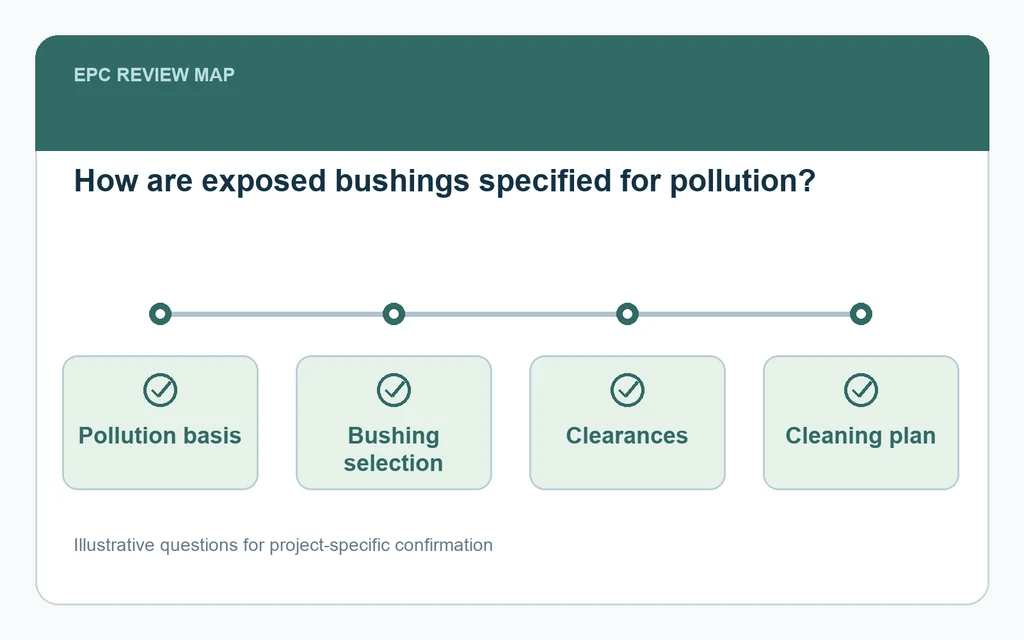
Select exposed bushings from the project's site pollution assessment and governing insulation requirements, independently of the metal-coating category. Confirm the adopted edition, exposed-bushing arrangement and supplier selection basis. Keep creepage and other dimensions open until the actual arrangement and utility requirements have been reviewed. 234
Coastal salt fog and airborne dust are inputs to outdoor-insulator selection. Ask for the site's pollution assessment, the owner's or utility's insulation requirements, the system and equipment voltages, and a drawing that identifies every exposed bushing and relevant external-insulation interface. A tank coating category does not establish the pollution duty of those surfaces.
IEC TS 60815-1:2025 covers selection and dimensioning of insulators in outdoor high-voltage systems under pollution and provides methods to evaluate site pollution severity. This second edition replaces the 2008 edition and distinguishes a severity value from a severity class. An IOGP/JIP33 supplementary specification calls for class e on exposed bushings within its contract scope. That clause does not establish class e for another project or resolve how a contract using an older edition should be stated under the 2025 edition.
Request the supplier's selection basis for the proposed bushing arrangement, including the applicable site severity, adopted edition and proposed dimensions. Have the electrical engineer check that basis against the utility requirement and offered drawing. Until those inputs and the actual configuration are reviewed, leave the pollution class, creepage and other acceptance dimensions open rather than copying a value from another coastal contract. 234
What evidence makes coastal offers comparable?
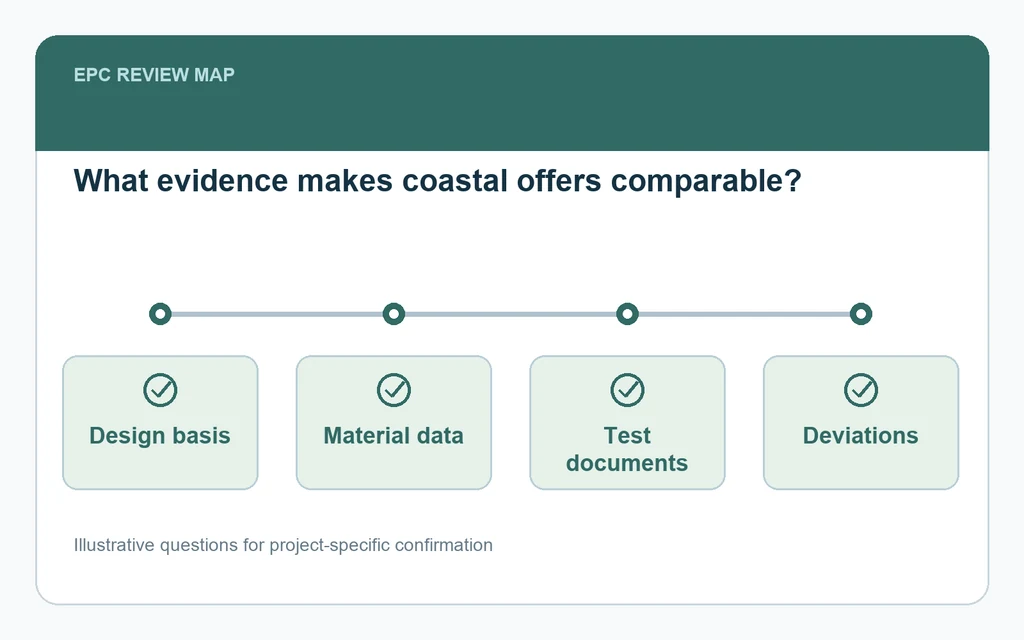
Compare coastal offers against one electrical and environmental specification before comparing price. Record each confirmed requirement, deviation and open item, then request component details, an inspection and test plan, and records tied to the offered configuration. Agree the receiving and handover checks before ordering. 891011
Put rated power, voltage ratio, vector group, impedance, losses, tapping, cooling, tank design, protection accessories, tests and documents on the same comparison sheet for every offer. Add the agreed corrosion requirement and exposed-bushing pollution requirement. I mark an absent value or document as open; I record a proposed exception as a deviation rather than treating silence as agreement.
For the offered model and configuration, request the exposed-component schedule and coating-system details, including surface preparation, coat count, specified dry-film thickness and tolerances where applicable. Ask for an inspection and test plan that names each planned check, its acceptance basis, witness arrangement and record. Utility procurement specifications provide examples of coating performance checks and clear inspection records; a proposed test or available inspection is not a completed result. A report used for acceptance must identify the tested component or model and the configuration it covers.
Check drawings and submittals by revision before manufacturing. The bushing arrangement, cooling surfaces, tank design and accessories in those documents should match the offered configuration. Keep an unreviewed line open until the responsible project team resolves it. For each agreed test, retain its acceptance record and the witness record if witnessing is specified.
Carry the agreed finish and inspection records into handover. Set the condition-on-receipt check and any applicable coating-repair instructions for the supplied assembly and its transport conditions. The owner should also decide whether special environmental or operating stresses call for a different mineral-oil sampling frequency or limit under its risk assessment and maintenance policy; there is no fixed coastal interval in this RFQ. Before ordering, make the document list and receiving responsibilities explicit. 891011
Which Inputs Require Final Confirmation?
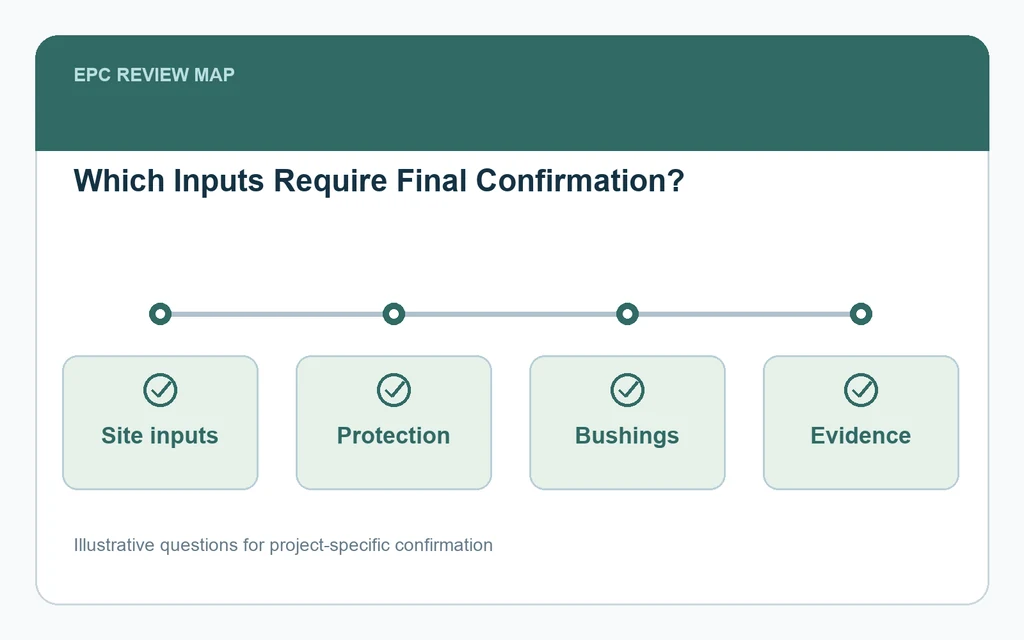
Send the project requirement or equipment list with rated power, voltage ratio, frequency, vector group, impedance, losses, tapping, cooling duty, tank preference, required accessories and quantity.
Include the site exposure and pollution assessments, adopted standards and editions, outdoor arrangement, transport limits, test and document requirements, and any witness arrangement. A single-line diagram, load list or nameplate can start the review when a full datasheet is unavailable. Keep unresolved coastal categories, bushing dimensions and acceptance records on the clarification list before ordering. 12810
References
- International Organization for Standardization (ISO). ↩ ↩ ↩ ↩ ↩ ↩
- International Electrotechnical Commission (IEC). ↩ ↩ ↩ ↩ ↩ ↩
- Sediver / CIGRE paper. ↩ ↩ ↩ ↩ ↩
- IOGP/JIP33. ↩ ↩ ↩ ↩ ↩
- Transformer for Coastal & Salt Fog Environments. ↩ ↩ ↩ ↩
- IOGP/JIP33. ↩ ↩
- Eaton. ↩ ↩
- Northern Ireland Electricity Networks. ↩ ↩ ↩ ↩ ↩
- PacifiCorp. ↩ ↩ ↩ ↩
- United for Efficiency. ↩ ↩ ↩
- International Electrotechnical Commission. ↩ ↩