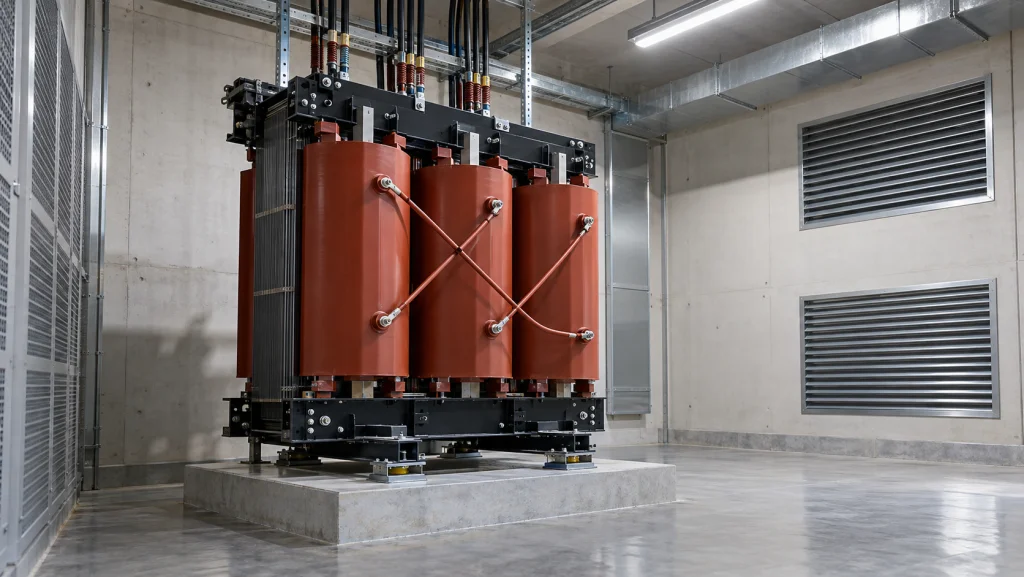
A quotation that says only “low noise” leaves an EPC electrical engineer without a clear basis for comparing equipment or assessing sound in an occupied room. For cast resin and VPI open-wound dry-type transformers, separate the equipment guarantee from the receiving-space requirement. I start with that separation because source output and sound at a particular location answer different questions.
Before issuing the RFQ, gather:
- The requested construction and rating, proposed enclosure and relevant operating states.
- The acoustic metric, weighting, proposed guaranteed value, measurement reference and conditions.
- The load condition, cooling mode and fan operation or control condition, where applicable.
- The room layout and dimensions, receiving locations and criterion sources, ventilation path, cable or busbar entry, and installation and service access.
Keep numerical room criteria unfilled until the project identifies their source. A building, data center, hospital or industrial-room label does not establish an acoustic limit. 1234
Which acoustic requirements belong in the RFQ?
Specify the equipment sound declaration and receiving-space criteria separately. Sound power describes source output; sound pressure depends on location and surroundings. Confirm the metric, weighting, operating conditions and contractual value before comparing offers or assessing the room. 125
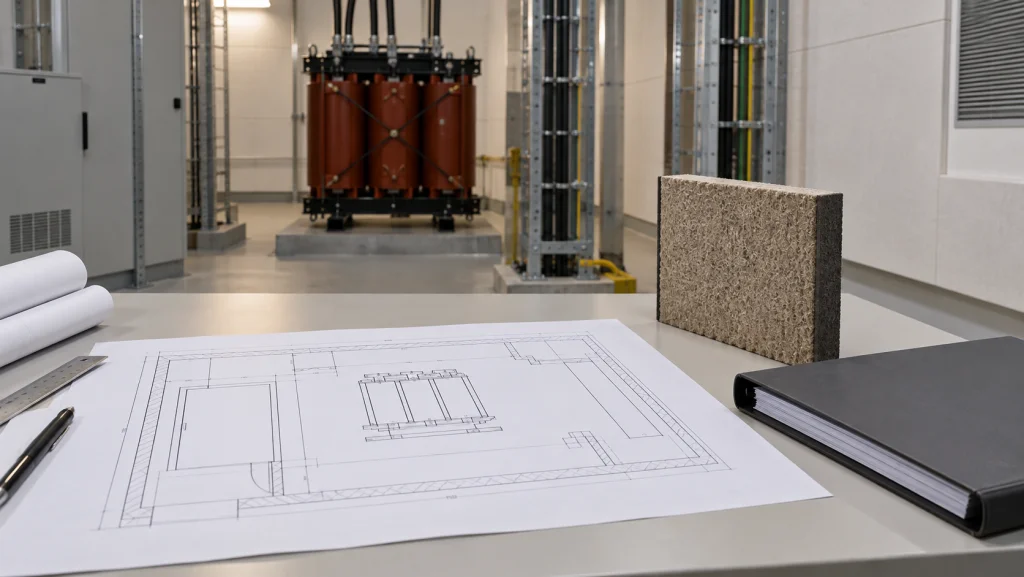
Sound power provides a basis for rating and comparing source output independently of receiver distance and environment. Sound pressure describes sound at a measurement location, where distance, room boundaries and background noise affect the result. A bare dB figure leaves that distinction unresolved; adding a weighting designation alone does not identify which quantity is declared.
Use two RFQ schedules, with project values left blank until agreed:
| Schedule | Information to record | Numerical value |
|---|---|---|
| Equipment declaration | Sound power or sound pressure; weighting; operating conditions; measurement method and geometry; contractual guaranteed value | ___ |
| Receiving-space criteria | Named receiving locations; applicable owner or local criterion and its source; assessment and acceptance conditions | ___ |
The equipment declaration supports supplier comparison. The receiving-space schedule defines what the room assessment must address. An equipment guarantee should therefore remain traceable to the room assessment without being treated as the room result.
Installation and ambient conditions can change field-measured sound relative to chamber measurements. Do not turn that observation into a fixed allowance between factory and room values. Before ordering, have the supplier confirm exactly what the guarantee covers and the project team identify the receiving locations, criterion sources and assessment needed. 125
How are cast resin and VPI offers compared?
Compare cast resin and VPI offers only after matching their declared acoustic metrics, configurations and operating states. Neither construction label establishes a noise ranking. Request a separate declaration for each relevant state, including fan-assisted operation where applicable. 234
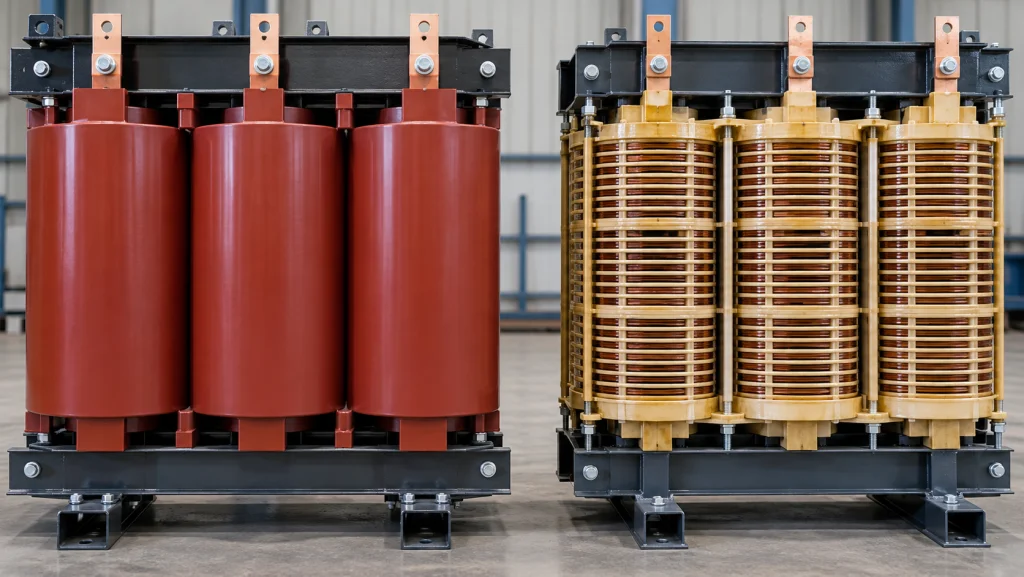
I compare the declared configuration before the sound figure because a lower number is useful only when its metric and conditions are comparable. The magnetic core is a principal sound source, while winding forces, enclosure panels, cooling fans, supports and installation surfaces can contribute to measured sound. Construction labels alone establish neither a quieter design nor equivalent performance.
Use one comparison schedule for the offered cast resin and VPI open-wound units. The blank cells below are template fields, not findings about an actual offer. Enter the identified model and rating for every relevant operating state.
| Construction and operating state | Model, rating, enclosure and load | Cooling mode, fan state and control condition | Acoustic metric, weighting and guarantee | Method, geometry and supporting report or test proposal |
|---|---|---|---|---|
| Cast resin: declared normal duty | ___ | ___ | ___ | ___ |
| Cast resin: fan-assisted duty, if applicable | ___ | ___ | ___ | ___ |
| VPI open-wound: declared normal duty | ___ | ___ | ___ | ___ |
| VPI open-wound: fan-assisted duty, if applicable | ___ | ___ | ___ | ___ |
Fan-assisted operation warrants separate consideration because forced-air cooling can increase total equipment noise. Do not add an assumed fan penalty to a no-fan declaration, or assume that switching off required cooling is an acceptable acoustic measure. Ask which load and cooling states the proposed guarantee covers, and check the declared fan condition against the proposed temperature-controller and fan logic.
Before ordering, resolve mismatched metrics and conditions. If a submission omits a field, mark it open for clarification rather than treating it as included. 234
How do transmission paths shape acoustic measures?
Match each acoustic measure to the transmission path it is intended to control. Review airborne sound and structure-borne vibration separately, then confirm that the proposed treatment suits the offered enclosure, cooling arrangement, installation interfaces and access before accepting it. 467
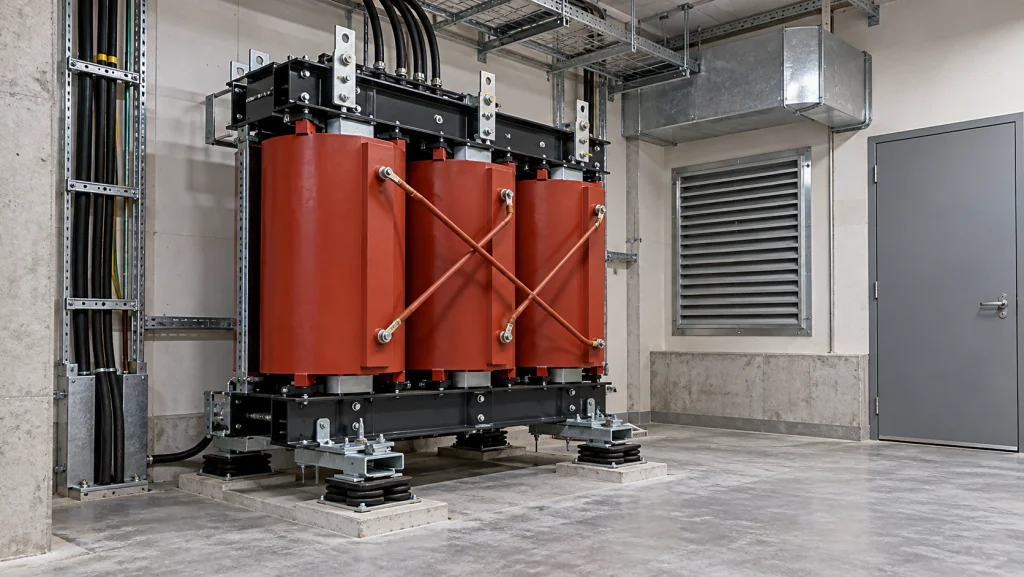
SGB-SMIT’s cast-resin planning guidance distinguishes airborne and structure-borne propagation and calls for different measures for each. Use that distinction to frame the appointed designer’s room assessment; it is not a performance guarantee for either offered construction.
A qualitative source–path–receiver diagram keeps the two questions visible:
Transformer → airborne sound and room reflections → receiving space
Transformer → supports and building structure → receiving space
Ask the designer to review the transformer location, room dimensions, surrounding and receiving spaces, reflective boundaries, supports and installation interfaces. Manufacturer examples of moving equipment away from reflective boundaries, adding room absorption, changing separating construction or increasing distance are options for assessment. Their suitability depends on the actual equipment and layout. Do not use those examples as a universal clearance or attenuation value.
| Proposed measure | Intended path or effect | Confirmation to request |
|---|---|---|
| Room absorption | Reduce airborne reflections | Assessment for the proposed room surfaces and receiving locations |
| Separating construction or increased distance | Reduce sound reaching the receiving space | Assessment using the actual room and receiving-space arrangement |
| Vibration-control proposal | Address transmission through supports and installation interfaces | Designer and supplier review of the proposed interfaces |
Room absorption alone does not demonstrate control of structure-borne transmission. Likewise, a vibration-control proposal does not establish the room’s airborne result.
Before ordering, review each proposed measure against the ventilation path, offered enclosure configuration, cable or busbar entry, installation route and service access. Keep explicit supplier questions alongside that review: which enclosure rating applies, how will temperature monitoring interface with protection, and what partial-discharge provisions, if any, form part of the proposed specification? Leave unanswered items open. Accept no treatment specification or claimed reduction merely from a generic room-treatment example. 467
What evidence supports factory acoustic acceptance?
Support the equipment guarantee with a report applicable to the offered configuration or an agreed acoustic test proposal. Confirm the governing reference, method, operating state and acceptance treatment before order release; a proposed test does not establish a completed result. 238910
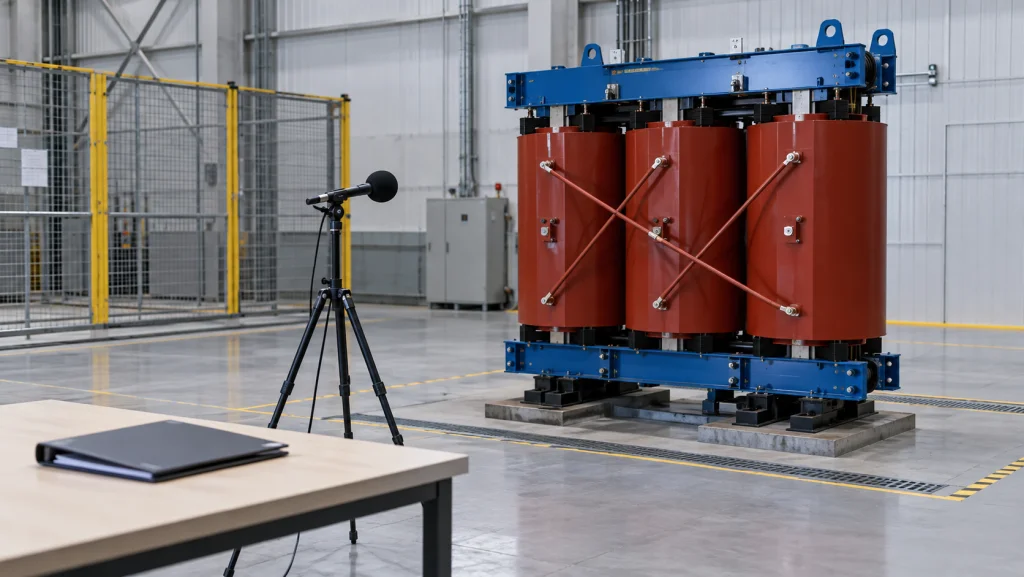
I read the guarantee alongside the proposed procedure because the measurement conditions determine whether the result can be compared with the contractual value. Request the relevant acoustic report or a proposed factory acoustic test plan, with an explanation of its applicability to the offered unit.
IEC 60076-10:2016, Edition 2.0, Power transformers - Part 10: Determination of sound levels, defines sound-pressure and sound-intensity measurement methods used to determine sound power for transformers, reactors and associated cooling devices within its stated scope. Those devices may be fitted to or separate from the transformer. Reference check date: 2026-10-20. Agree the project-adopted edition and its applicability to the offered dry-type configuration; the reference does not replace the contractual sound value or receiving-space criterion.
Keep the declaration, completed report and proposed testing distinct:
| Requested item | Configuration reference to record | Status to record |
|---|---|---|
| Guaranteed acoustic declaration | Offered model, rating, enclosure, load, cooling and fan conditions | Supplier confirmation and project review |
| Relevant acoustic report | Report identifier; tested model, rating, enclosure, cooling configuration and stated conditions | Report submitted and reviewed, with applicability addressed |
| Proposed acoustic test plan | Proposed unit or configuration, operating states, method and acceptance treatment | Test proposed; availability and scope subject to confirmation |
A report for a different configuration needs an applicability explanation. Do not treat a generic brochure, a proposed test or unconfirmed test availability as a completed result for the offered unit.
For the procedure review, ask the supplier to state:
- Governing reference, edition and applicable clause.
- Acoustic metric and tested configuration.
- Load, cooling mode and fan operating condition.
- Measurement geometry and averaging or calculation method.
- Background-noise treatment and proposed acceptance tolerance.
A historical Federal Pacific note on low-voltage dry-type testing illustrates why geometry, averaging and ambient adjustment need attention. Its procedure should not be copied into every cast resin or VPI RFQ.
Before ordering, align the proposed procedure with the guaranteed value and agree the acceptance treatment. Record separately whether a report has been reviewed, a test is proposed, or availability remains unconfirmed. 238910
How are room results verified and accepted?
Verify room performance against named receiving-space criteria through a separate project plan. Agree locations, operating states, background-noise treatment and acceptance evidence, then assign responsibility for declarations, assessment, measures and acceptance. A factory result cannot establish room compliance through a fixed correction. 2456
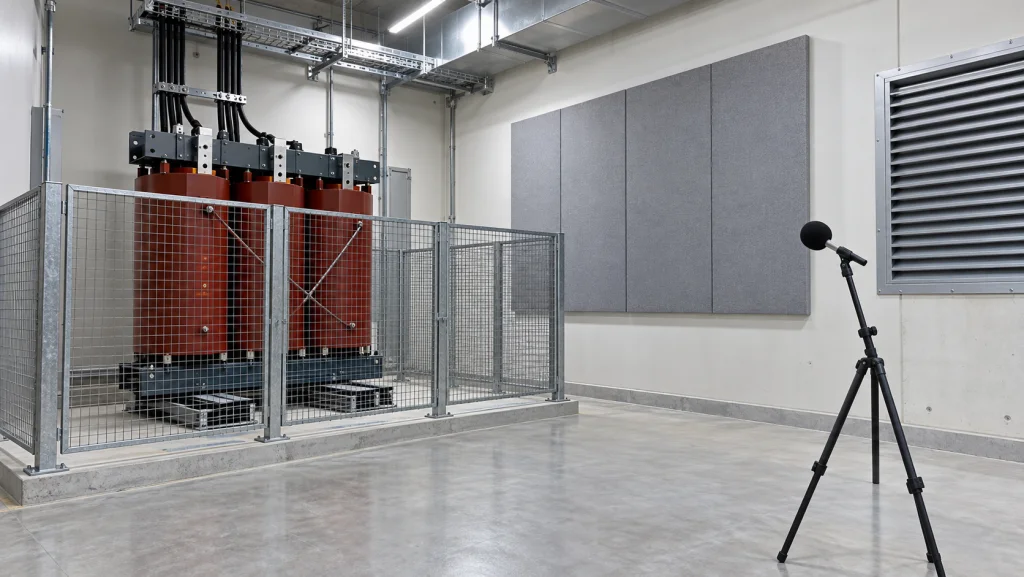
The installed result depends on receiving location, room conditions and transmission paths. Eaton’s general-purpose dry-type design guidance describes how installation and ambient conditions can increase field-measured sound relative to chamber measurements. That observation supports a separate room assessment, not a fixed factory-to-room conversion.
Ask the project team to approve a room-verification plan identifying each receiving location, the applicable criterion and its source, relevant transformer and cooling states, background-noise treatment and the evidence needed for acceptance. Have the appointed acoustic designer identify any additional source information needed for the assessment, then ask the supplier to confirm its availability.
Consolidate the RFQ schedules into one responsibility matrix. The assignments below are recommendations to agree for the project, not predetermined contractual roles or a statement of ZoeTransformer’s service scope.
| RFQ work item | Record to agree | Project assignment to confirm |
|---|---|---|
| Equipment declaration | Configuration, operating states, metric, guarantee and measurement conditions | Who supplies it and who reviews it |
| Room assessment | Layout, receiving locations, criterion sources and transmission paths | Who performs and accepts the assessment |
| Acoustic measures and equipment interfaces | Intended path, proposed effect, cooling, enclosure and access compatibility | Who reviews the proposal and implements approved measures |
| Factory acoustic acceptance | Applicable report or agreed procedure, configuration and acceptance treatment | Who reviews the submission and accepts the result |
| Room verification | Locations, criteria, operating states, background treatment and acceptance record | Who performs verification and accepts the room result |
| Open assumptions and deviations | Unresolved items and the approval affected | Who resolves each item before that approval |
Before ordering, confirm the equipment declaration, acoustic evidence status and agreed verification arrangements. Assign building assessment, implementation and site verification explicitly rather than assuming they follow from transformer supply. Keep remaining assumptions and deviations visible before the relevant project approval. 2456
Which Inputs Require Final Confirmation?
For this acoustic RFQ, send the proposed transformer construction and rating, enclosure and cooling arrangement, relevant operating states, room layout and receiving-space criteria with their sources.
Request a configuration-linked equipment declaration and relevant acoustic report or proposed test plan. Before ordering, resolve mismatched metrics, clarify open submissions and responsibilities, and agree separate factory acceptance and room-verification arrangements. Use that schedule to support the project’s acoustic design and formal acceptance. 2346
References
- ANSI preview of IEC 60076-10. ↩ ↩ ↩
- Transformer Noise Specification Guide for EPC Projects. ↩ ↩ ↩ ↩ ↩ ↩ ↩ ↩ ↩ ↩
- ZSO Power. ↩ ↩ ↩ ↩ ↩ ↩
- Low-Noise Dry-Type Transformer for Buildings. ↩ ↩ ↩ ↩ ↩ ↩ ↩ ↩
- Eaton. ↩ ↩ ↩ ↩
- SGB-SMIT. ↩ ↩ ↩ ↩ ↩
- Eaton / Crouse-Hinds. ↩ ↩
- International Electrotechnical Commission (IEC). ↩ ↩
- International Electrotechnical Commission (IEC). ↩ ↩
- Federal Pacific. ↩ ↩