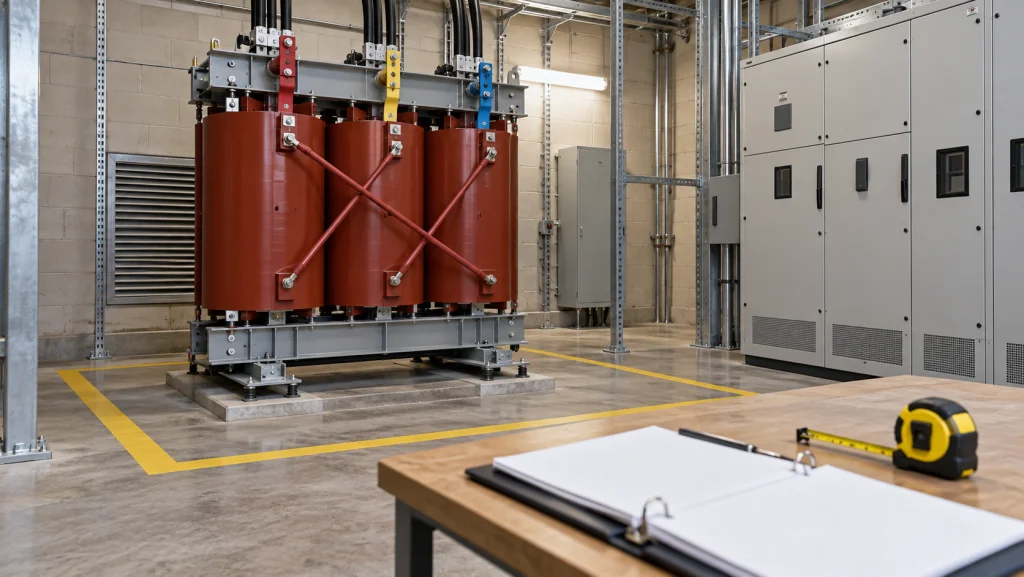
A matching kVA rating does not establish whether a replacement transformer fits the room, passes through the building or connects to the existing power and control circuits. If you are an EPC electrical engineer preparing an indoor cast resin or VPI open-wound replacement RFQ, those interfaces need separate records. I start by separating the installed unit's documented facts from the proposed requirements, because copying the old nameplate can carry an unresolved assumption into every quotation.
Gather these inputs before comparing proposals:
- Readable nameplate photographs, the original specification or datasheet, general-arrangement drawings and available previous test reports.
- The single-line diagram, representative loading records, operating pattern and planned load changes.
- Measured room limits, enclosure dimensions, foundation or rail spacing, surrounding space and access-route restrictions.
- Dimensioned HV, LV and neutral connections, cable or busbar arrangements, entry directions and grounding drawings.
- Protection and control diagrams, accessory records, temperature-monitoring circuits and auxiliary-supply details.
- Room ventilation arrangements, recorded environmental conditions and any supplied owner fire or acoustic criteria.
Identify each document's revision and each observation's date and source. Keep unanswered requirements open rather than treating them as included in the replacement scope. 123456
Which existing records establish replacement requirements?
Separate the installed unit's records, current site observations and proposed replacement requirements before copying any value into the RFQ. Reconcile nameplate data and available drawings with representative loading, planned changes and the single-line diagram, then obtain engineering confirmation of the replacement duty. 126
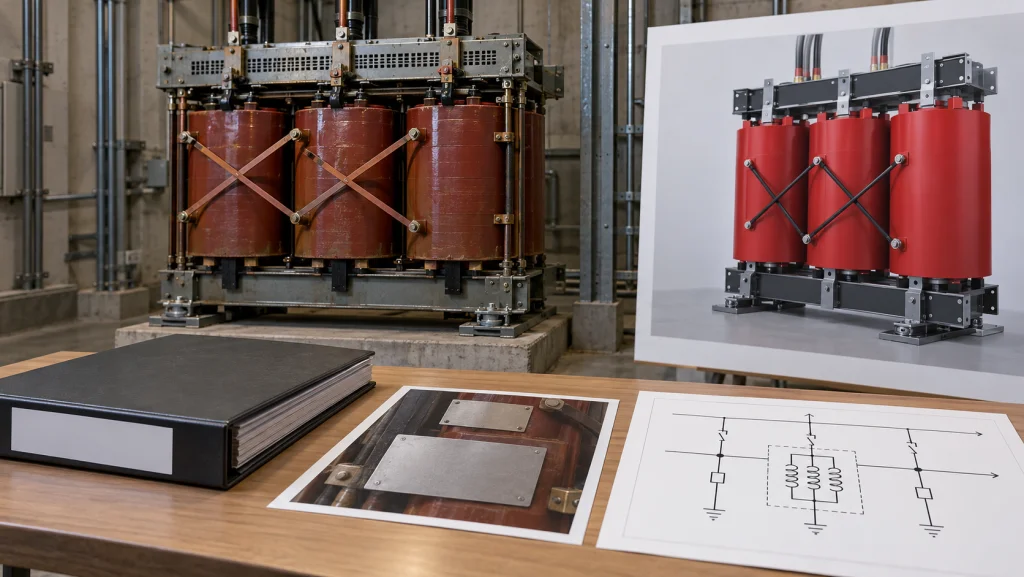
Start an unfilled comparison for each equipment tag. The following format keeps historical information, current observations and proposed requirements distinguishable; it is a procurement comparison aid rather than a prescribed standard.
| Record category | Value or requirement | Source, revision or observation date | Verifier, discrepancy and supplier response |
|---|---|---|---|
| Existing-unit fact | — | — | — |
| Current site observation | — | — | — |
| Proposed replacement requirement | — | — | — |
| Discrepancy requiring review | — | — | — |
Request readable nameplate photographs, the original technical specification or datasheet, general-arrangement drawings and available previous reports. Check that each record identifies the relevant equipment. A previous test report describes the equipment and configuration it identifies; it does not establish the performance of a proposed replacement.
Where drawings are incomplete, supplement them with direct measurements and photographs. Record who verifies the observations and when, and retain discrepancies rather than silently choosing between conflicting records.
Then compare the loading records with the expected operating pattern and planned changes. Check whether the recorded period represents the replacement's expected duty. Existing loading alone does not account for a planned change in connected loads or operation.
Alongside the single-line diagram, record existing values separately from engineer-defined replacement requirements, and ask the supplier to specify in its proposal the rated power, winding voltages, frequency, phase, vector group, neutral arrangement, impedance, tapping and cooling for the proposed replacement where applicable. Retain any verified existing tap position as reference information, separately from the proposed tapping requirements.
Before issuing the ordering specification, obtain project engineering review of the proposed duty and resolve which legacy values remain applicable. 126
Which site measurements establish fit and access?
Treat final-position fit and access through the building as separate checks. Compare measured room limits, mountings and surrounding space with the proposed dimensions, then reconcile old-unit removal and new-unit delivery records with sourced weights, handling provisions and the proposed delivery configuration. 1346
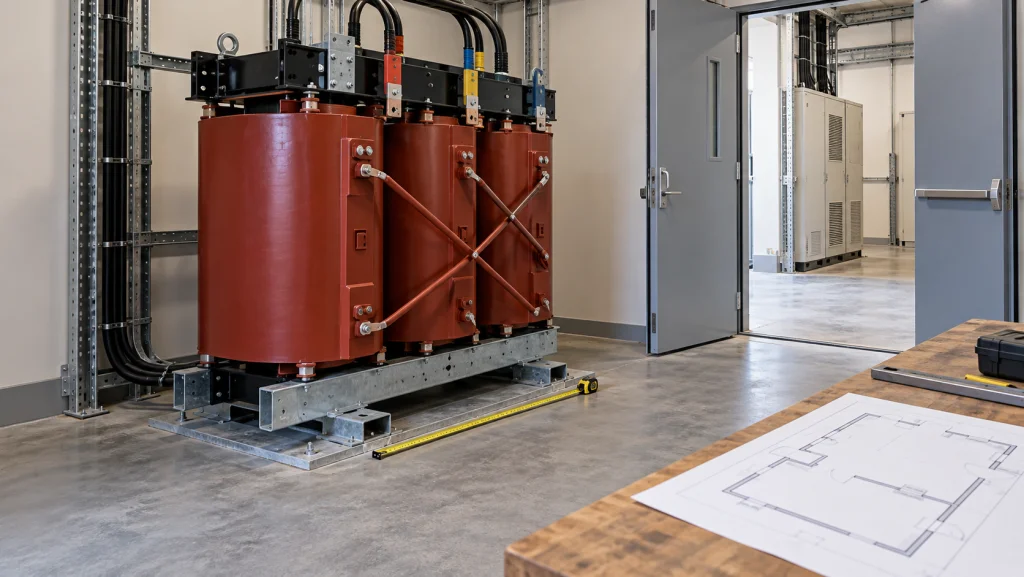
When I review a replacement GA drawing, I compare the proposed dimensions with measured site limits and the access route before treating the outline as a match.
Keep three dimensional records separate:
- Existing-unit dimensions: the transformer and enclosure dimensions, orientation, and foundation or rail spacing recorded for the installed equipment.
- Measured site limits: room dimensions, mounting constraints, surrounding equipment and available space at the installation position.
- Proposed-unit dimensions: the supplier's drawing dimensions, mounting arrangement and stated delivery configuration.
Use consistent units and an agreed orientation reference. Link measurements and photographs to their dates and site verifiers. Photographs help explain the arrangement, but they do not replace dimensions needed for comparison.
Available surrounding space is a site measurement. Required clearance is a separate requirement to obtain for the proposed model. A footprint comparison therefore needs both the measured installation envelope and the supplier's applicable clearance and access requirements.
Maintain separate records for old-unit removal and proposed-unit delivery. Include route dimensions, restrictions and surrounding equipment, together with separately sourced weights and handling provisions for each unit. The old transformer's handling arrangement does not establish what is suitable for the replacement.
Ask the supplier to identify dimensional matches and deviations against the recorded limits. Have the responsible project parties review the route against the proposed delivery configuration and handling provisions. Where feasibility remains unresolved, keep it open for assessment rather than accepting final-position fit as sufficient.
Complete the ordering review against the supplier's identified drawing revision, with the installation envelope and both access records reconciled. 1346
Which room conditions constrain the proposed construction?
Assess the room against the proposed cast resin or VPI open-wound construction and enclosure. Record ventilation paths, openings, obstructions, service space and environmental conditions, then obtain the selected model's requirements and resolve conflicts with the measured room before ordering. 56789
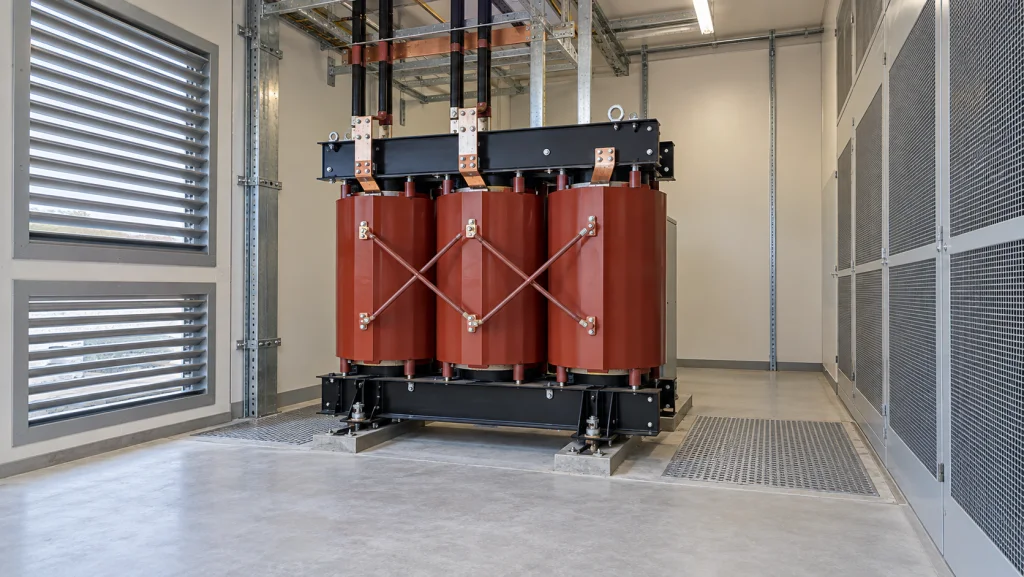
Show the room and enclosure ventilation paths, measured inlet and outlet dimensions, obstructions and available panel-removal or maintenance space. Record whether openings remain unobstructed for ventilation. A familiar enclosure footprint does not establish that the proposed unit has the airflow or service access its instructions require.
VPI guidance addresses airflow over cooling surfaces, inlet and exhaust dimensions, and space to remove an enclosure side panel. Compare these features with the selected VPI model rather than assuming that the existing enclosure arrangement remains suitable.
Include mounting geometry and space below the active part in that comparison. The Raychem RPG VPI manual requires fixing the supplied rollers for proper air circulation and providing sufficient height below the active part for ventilation. Those instructions remain within that manual's equipment scope; they are not a universal mounting prescription for dry-type transformers.
For a cast resin proposal, obtain the selected cast resin model's instructions. Do not transfer a VPI mounting arrangement or another manufacturer's numerical clearance to it.
Record ambient temperature range, altitude, humidity, condensation, dust, corrosive exposure and vibration. Attach any supplied owner fire or acoustic criteria. Alongside those room records, ask which enclosure protection rating, ventilation requirements, noise acceptance basis and temperature-monitoring arrangement apply to the proposed unit. Is a partial-discharge acceptance requirement specified for the offered construction? Leave unanswered requirements open.
Request the supplier's response to the recorded conditions and its model-specific ventilation and clearance requirements. Resolve conflicts between those requirements, the enclosure and the measured room before placing the order. 56789
Which records establish connection and grounding compatibility?
Connection compatibility requires a dimensioned comparison of HV, LV and neutral terminals, cable or busbar approaches, and grounding interfaces. Use a shared orientation reference, identify differences on the proposed drawings, and resolve those differences through project review before treating the connections as compatible. 1610
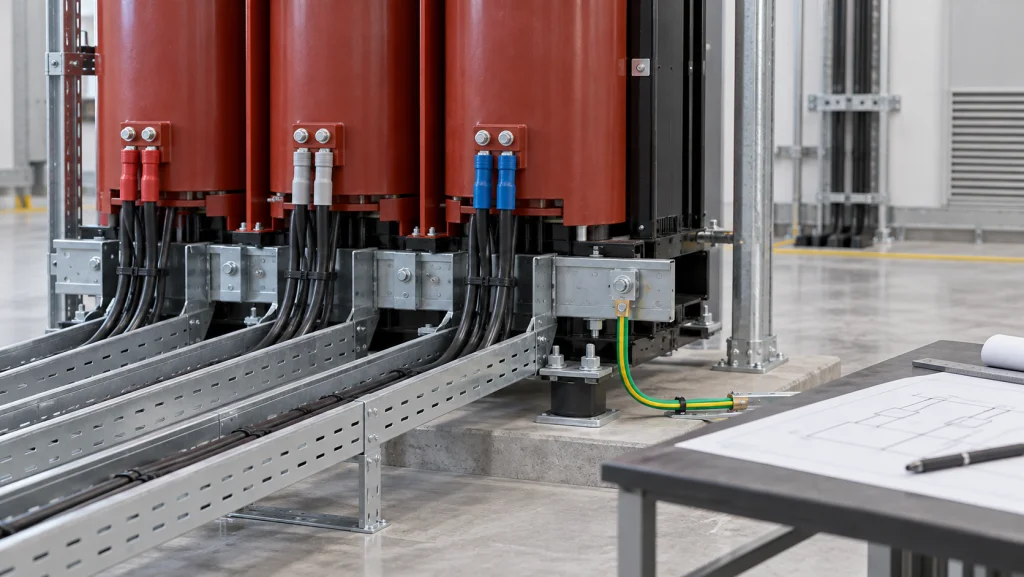
Prepare an interface schedule using the terminal labels and rated voltages in the relevant equipment records. Agree the orientation reference before comparing terminal positions so that the existing measurements and proposed drawings describe the same physical arrangement.
| Interface record | Existing measurement or drawing | Proposed drawing and revision | Difference and review status |
|---|---|---|---|
| HV, LV and neutral terminal positions and dimensions | — | — | — |
| Cable-entry directions and cable or busbar arrangements | — | — | — |
| Connection space and applicable electrical clearances | — | — | — |
| Transformer-body and enclosure grounding connections | — | — | — |
Attach the connection and grounding drawings. Supplement them with photographs showing terminals, cable or busbar approaches and surrounding equipment. Photographs explain geometry; measured dimensions and connection drawings provide the comparison needed to reconcile the interfaces.
For the cast resin equipment covered by Siemens' operating instructions, sufficient space must be provided for cable connection and the necessary electrical distances, and the transformer body and enclosure must be reliably grounded. Keep those instructions within their documented scope and obtain the proposed unit's own connection and grounding requirements.
Ask the supplier to reference its proposed terminal and grounding arrangements against each recorded interface. Record deviations explicitly, including differences requiring project review, rather than accepting an overall outline match as confirmation of connection compatibility.
Before ordering, reconcile the actual terminal geometry, entry directions and grounding interfaces against the identified supplier drawing revision and record the project review outcome. 1610
How do monitoring controls interface with protection?
Trace temperature monitoring from each sensor and controller to the actual alarm, trip, fan-control and monitoring destinations. Compare device characteristics, terminals, settings and auxiliary power with the proposed circuits, then resolve differences through project review rather than assuming accessory names establish compatibility. 1111213
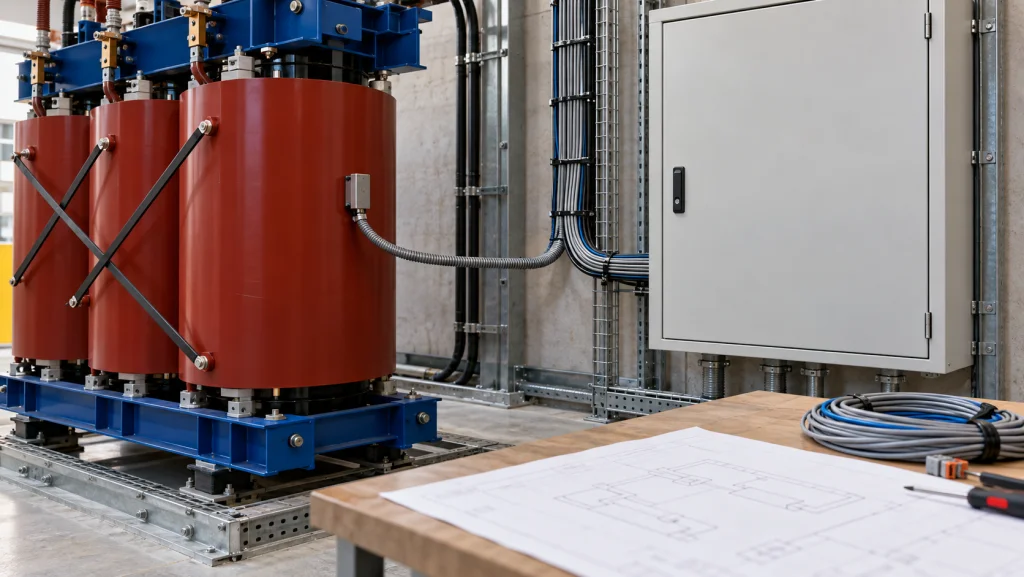
My priority is a traceable path from the sensor to the receiving circuit, because an accessory list naming a temperature monitor does not establish the electrical interface.
Use the existing protection and control diagrams, accessory records and terminal information to build the comparison below. Record existing approved settings as existing information, separately from proposed replacement settings.
| Record category | Existing circuit information | Proposed response or difference |
|---|---|---|
| Sensors and controller | Device identities, sensor types and locations, approved settings | — |
| Outputs and external wiring | Alarm, trip and fan functions; contact characteristics; terminals and destinations | — |
| Auxiliary supply | AC or DC, voltage, frequency where relevant, source and protective switching | — |
| Site-monitoring connection | Documented interface, terminals and receiving destination, where present | — |
Manufacturer examples explain why these details need checking. The Siemens dry-type transformer operating manual describes PT100 winding sensors and alarm and trip connections to upstream relay protection. For the equipment it covers, the manual prohibits direct controller supply from the transformer LV bus unless protection switching is provided, citing possible controller damage from inrush current.
That restriction is specific to the documented equipment. Its sensor choice and settings do not establish defaults for another controller. Likewise, contact forms, output functions, supply ratings and terminal characteristics must match the selected devices and the actual receiving circuits.
Ask the supplier to respond to the existing circuit records and identify proposed differences. Where site documents identify a monitoring connection, include its documented characteristics without assuming a communication arrangement. Resolve the control, supply and destination-wiring differences through project review before ordering. 1111213
How are supplier drawings and deviations reconciled?
Reconcile each supplier drawing and commitment with the sourced replacement requirements, measured limits and interface records. Keep deviations and unanswered items visible, confirm the project acceptance basis, and agree the relevant drawing, inspection and document scope before treating the offered configuration as settled. 161415
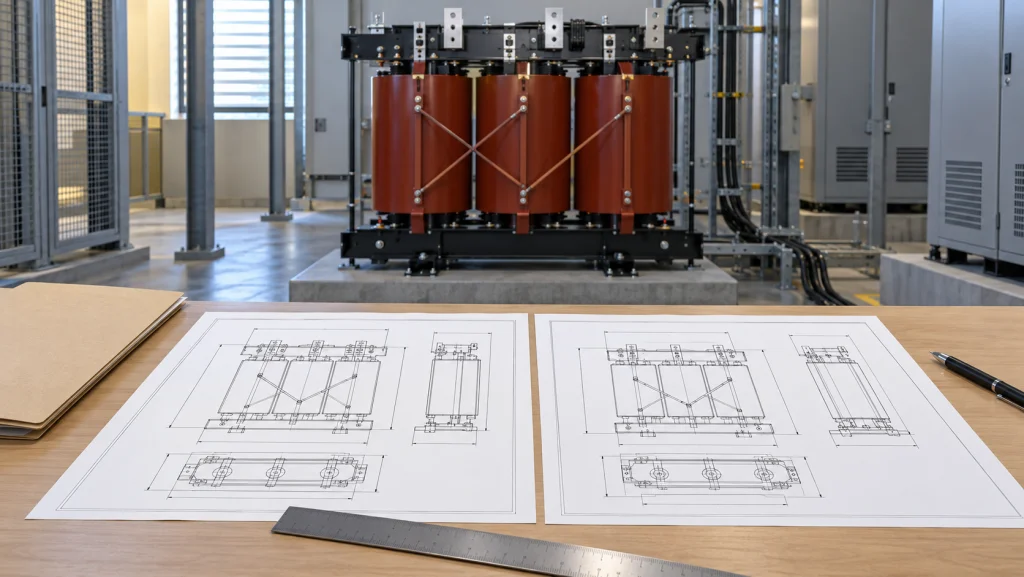
Consolidate the legacy records, measured constraints, proposed requirements and interface schedules into one RFQ response register. For each item, record the requirement's source and revision, the supplier's drawing reference or response, any deviation, and the responsible project reviewer.
I keep an unanswered interface open even when the quotation describes the transformer as a replacement. Ask for explicit dimensional responses and document commitments; a missing response does not establish that an item is included.
Attach the project-selected standards and supplied owner or utility acceptance requirements. Confirm the project-adopted edition and the offered unit's applicability. Check product scope before accepting a reference: IEC 61558-1:2017, for example, expressly excludes equipment forming part of a distribution network. Keep unresolved reference metadata out of the agreed specification until it is resolved.
Distinguish compliance statements, certificates and model-specific test reports. A report used to demonstrate a completed test must identify the equipment and configuration it covers; an old-unit report does not establish testing of the replacement.
If dimensional inspection, document review or a witness arrangement is requested, ask the supplier to confirm availability and scope separately. Factory checks of the proposed equipment cannot validate the accuracy of site measurements.
Where procurement depends on an interruption window, ask the owner what interruption is permitted, which loads are affected, what continuity constraints apply, where site-work responsibilities begin and end, and who approves the arrangement. Keep unanswered fields open.
Before ordering, reconcile the drawing revisions, dimensional responses, interface deviations and agreed document commitments, with a recorded project review outcome for each remaining issue. 161415
Which Inputs Require Final Confirmation?
Start the replacement RFQ with the old nameplate, available drawings, single-line diagram and current site records. Keep existing facts, measured limits and proposed requirements separate, then ask the supplier to respond against the same fit, access, ventilation, connection and monitoring interfaces.
Before ordering, reconcile the proposed drawing revisions and explicit deviations through project review. Leave unanswered interfaces open and confirm the relevant inspection and document scope. The RFQ prepares that procurement discussion; it does not replace project design or formal approval. 1615
References
- Honleele; Toplit Transformer. ↩ ↩ ↩ ↩ ↩ ↩ ↩ ↩ ↩ ↩ ↩ ↩
- Transformer Replacement Program Implementation Manual. ↩ ↩ ↩
- Toplit Transformer. ↩ ↩ ↩
- CNEEG; cnbbelc. ↩ ↩ ↩
- cnbbelc. ↩ ↩ ↩
- Transformer Procurement Guide - ElevGrid. ↩ ↩ ↩ ↩ ↩ ↩ ↩ ↩ ↩ ↩ ↩ ↩
- Hammond Power Solutions. ↩ ↩
- Raychem RPG. ↩ ↩
- Hitachi Energy. ↩ ↩
- Siemens. ↩ ↩
- Siemens Energy. ↩ ↩
- Eaton. ↩ ↩
- COMEM. ↩ ↩
- International Electrotechnical Commission. ↩ ↩
- Can You Inspect Power Transformers Before Shipment?. ↩ ↩ ↩