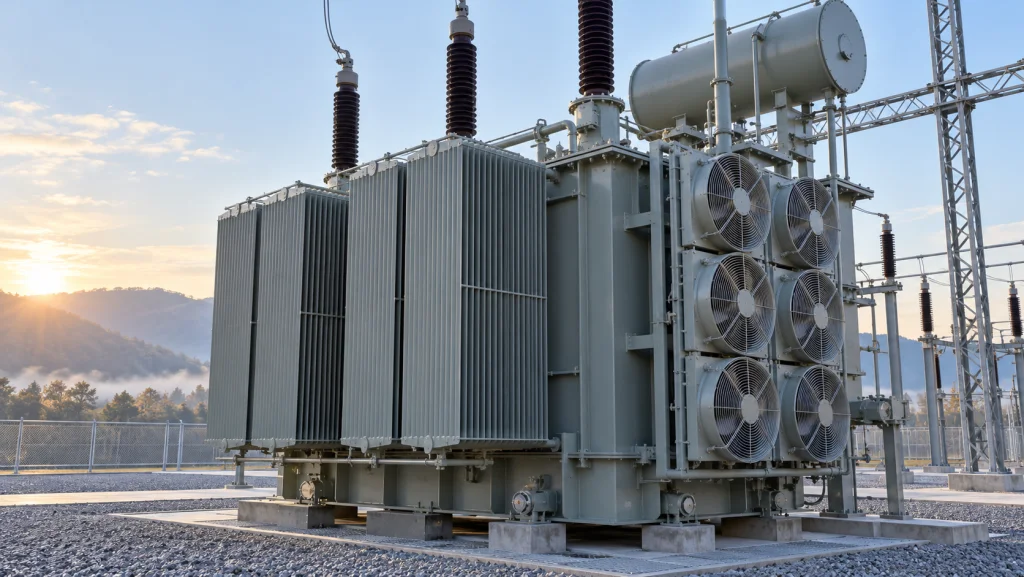
An ONAN/ONAF entry in a transformer quotation identifies cooling methods, but your EPC electrical engineer still needs the capacity and operating conditions offered for each mode. I start with the separate cooling-mode ratings because a cooling code alone does not tell your procurement team which capacity it is comparing.
Before issuing the RFQ, collect these inputs and questions:
- The requested ONAN and ONAF MVA declarations, with the operating and thermal conditions and applicable tap-position coverage to be confirmed.
- The proposed radiator and fan arrangement for the project’s service conditions.
- The fan operating modes, control interfaces and motor protection to be clarified.
- The contractual temperature-rise standard edition and the proposed test basis for each declared rating.
Keep these questions tied to the offered oil-immersed transformer configuration. Utility specifications provide useful examples, but their requirements do not automatically become requirements for your project. 123
How do ONAN and ONAF cooling differ?
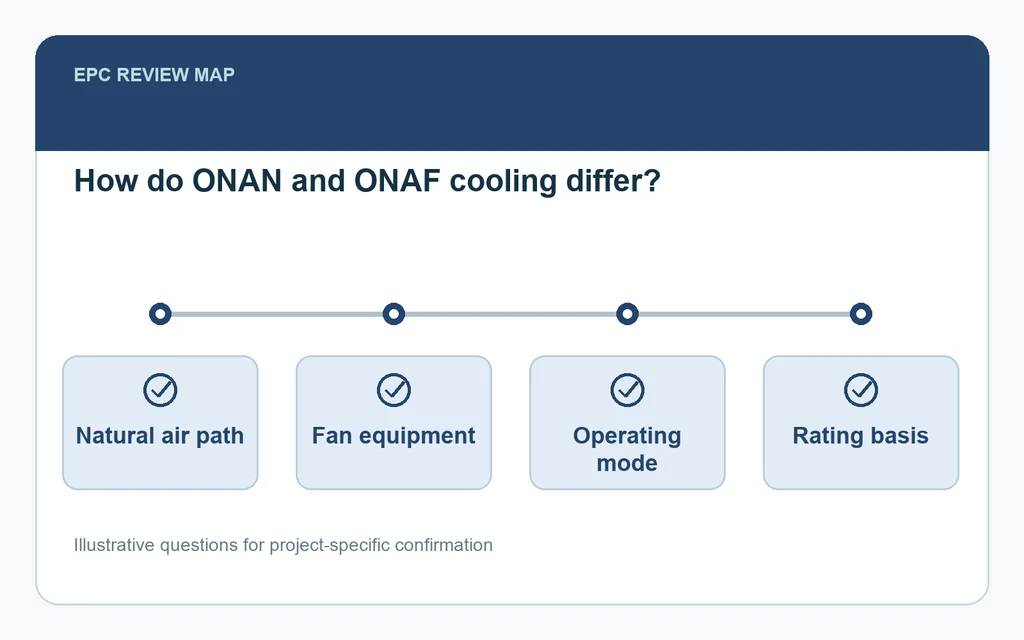
Thermofin defines the cooling mechanisms separately: ONAN uses natural oil circulation and natural airflow; ONAF uses natural oil circulation and forced airflow. Siemens Energy’s example concerns ONAF only. Before ordering, confirm the offered rating and radiator-and-fan configuration rather than treating the code as a complete package. 14
Thermofin defines the two designations in its transformer-radiator brochure:
| Cooling code | Oil circulation | Airflow |
|---|---|---|
| ONAN: Oil Natural–Air Natural | Natural | Natural |
| ONAF: Oil Natural–Air Forced | Natural | Forced |
The forced element in ONAF is airflow, not oil circulation. A Siemens Energy phase-shifting transformer example describes an ONAF arrangement with tank-mounted radiators, fans and no pumps. That example concerns ONAF only; it does not specify the package or capacity of another transformer.
For your RFQ, keep the cooling designation separate from the supplier’s capacity declaration and equipment description. Neither the terminology nor that example establishes a generic capacity increase, fan specification or complete cooling package. Before ordering, check that the quotation identifies both the cooling mode and the arrangement offered for it. 14
Which cooling ratings must the RFQ clarify?
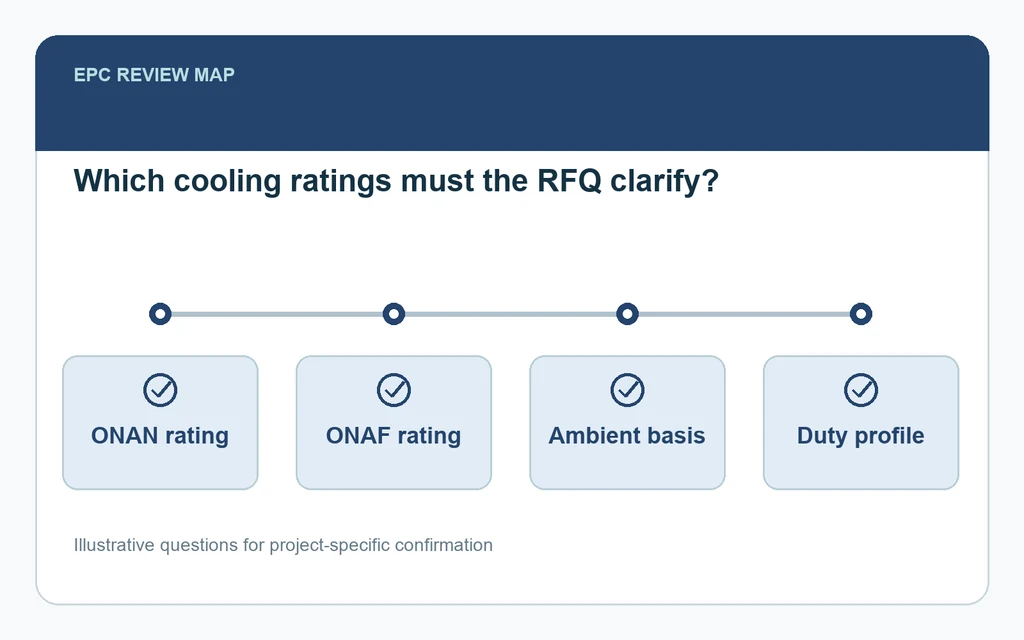
Request separate offered ONAN and ONAF MVA ratings, their operating and thermal conditions, and applicable tap-position coverage in your EPC RFQ. Before ordering, confirm the supplier’s rating schedule and obtain separate configuration-specific instructions for fan failure or auxiliary-supply loss. 23
For your procurement engineer, the useful comparison is a supplier-completed schedule:
| Information to clarify | ONAN declaration | ONAF declaration |
|---|---|---|
| Offered power | MVA to confirm | MVA to confirm |
| Operating and thermal conditions | Supplier to state | Supplier to state |
| Applicable tap-position coverage | Supplier to identify | Supplier to identify |
Cooling selection depends on individual service conditions, as Siemens Energy explains. A generic uprating percentage therefore cannot replace the offered rating schedule and its conditions.
Natural-cooling capacity also needs careful interpretation. NIE Networks’ transformer specification requires at least 70% of rated power during ONAN operation and permits additional cooling through ONAF or OFAF. The 70% minimum belongs to that document; it is not a universal ONAN/ONAF ratio. Confirm its applicability to your project before adopting the requirement in a contract.
A declared ONAN rating and permission to operate after a cooling failure are separate questions. Ask the supplier what operation is permitted after partial fan failure or loss of auxiliary supply, including any permitted load and duration. Keep those answers open until configuration-specific instructions are agreed; do not derive them from the utility minimum.
Before ordering, reconcile the separate ratings, their conditions and tap coverage, then resolve the cooling-failure questions independently. 23
What radiator arrangement and fan controls are offered?
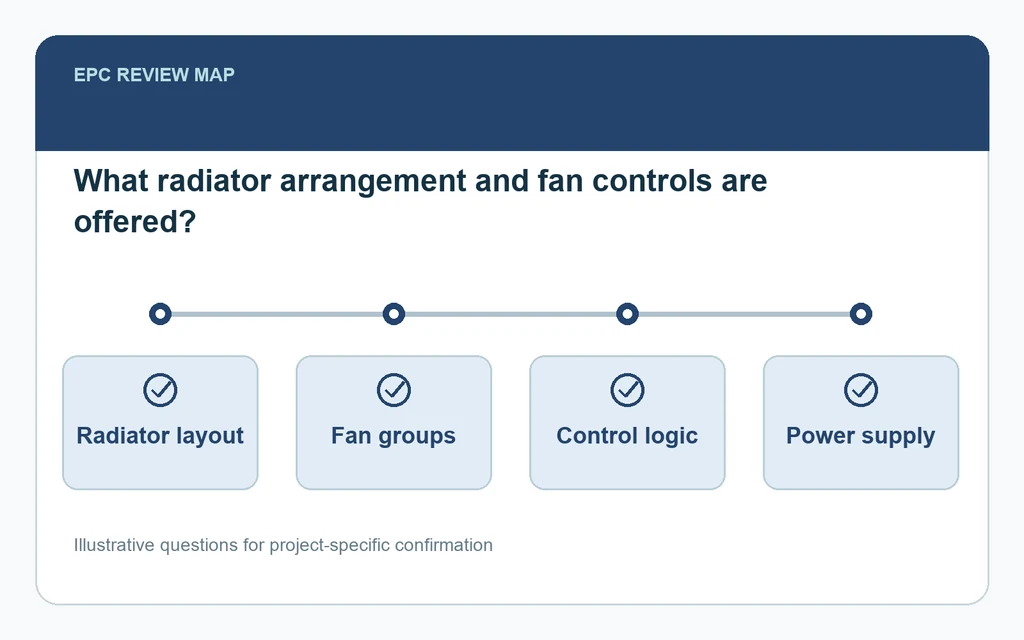
Confirm the physical cooling arrangement and how its fans operate. Ask the supplier which operating modes, control interfaces and motor protection apply to the offered configuration, and resolve auxiliary supply, fan stages and temperature-based switching settings before ordering. 234
I check the proposed radiator and fan arrangement alongside the operating configuration before comparing cooling offers. Siemens Energy’s power-transformer brochure explains that cooling methods depend on individual service conditions and that radiator banks or coolers can be attached to the transformer or installed separately.
Siemens Energy’s phase-shifting transformer example uses tank-mounted radiators, with fans selected to meet that project’s low-noise requirement. Ask how a project-specific fan requirement affects the proposal; the example supplies no default fan quantity or noise value for your transformer.
The control description needs similar precision. NIE Networks’ transformer specification describes automatic switching at preset winding-temperature values. Those requirements belong to that specification; confirm its applicability to your project before adopting that control example. Its discussion includes fans and pumps; it does not change ONAF’s natural-oil-circulation meaning.
Ask the supplier:
- What auxiliary supply does the proposed fan system use?
- How many fan stages are proposed, and how do they operate?
- Which automatic, local manual and remote operating modes are offered?
- What temperature-based switching settings and control interfaces are proposed?
- What thermal-overload and overcurrent protection is included?
These are questions for the offered configuration, not prescribed default values. Before ordering, resolve the equipment arrangement and each applicable control question rather than accepting “fans included” as the complete description. 234
What temperature-rise evidence supports each offered rating?
Agree the contractual standard edition and proposed temperature-rise test basis for the offered configuration and each declared rating. Before ordering, clarify the proposed report’s model, configuration, tested rating and cooling mode, and distinguish a proposed report from a completed test record. 3
NIE Networks’ transformer specification sets out provisions for temperature-rise testing and test documentation. Those provisions belong to that specification; they do not establish the contractual test basis for another offer. Confirm the edition adopted by your contract.
For any proposed temperature-rise report, ask how it will identify the model, configuration, tested power rating and cooling mode, and how it relates to the agreed test basis. A proposed report is a request for evidence, not a completed test record.
Before ordering, agree the contractual edition, the proposed test basis for each offered rating and the identification needed to connect any report to the offered configuration. 3
Which Inputs Require Final Confirmation?
Before ordering, bring the cooling decision back to four connected checks: separate ONAN and ONAF ratings with their conditions; the offered radiator and fan arrangement; the controls and configuration-specific cooling-failure instructions; and the agreed temperature-rise test basis.
Send the relevant cooling specifications and supplier declarations for clarification, keeping unanswered items open until the offered configuration and its evidence are agreed. 23