2500 kVA 10 kV Dry-Type Transformer
A 2500 kVA dry-type distribution transformer for a 10 kV primary-voltage requirement. Start with the electrical load and transformer-room conditions, then confirm the secondary voltage, cooling rating, enclosure and terminal arrangement for your project. Suitable selection depends on the complete specification, not capacity alone.
- Rated capacity2500 kVA
- Voltage ratio10 kV primary

Specifications
2500 kVA - Reference schedule for quotation · Revision 3. Confirmed values apply as listed. Configuration options and project confirmation items are settled in the quotation for your specification.
| Parameter | Value | Status |
|---|---|---|
| Rated capacity | 2500 kVA | Confirmed |
| HV winding rated voltage | 10 kV | Confirmed |
| Reference data basis | BEZ aTSE 838/10Third-party published reference design for preliminary comparison, not Zoe guaranteed performance. Source and limitations are in the linked reference sheet. | Project confirmation |
| Reference voltage ratio | 10 / 0.4 kV10/0.4 kV is a reference selection within the source ranges. Reference facts are not Zoe tested performance. | Project confirmation |
| Reference frequency | 50 HzSelected reference duty, not a dual-frequency nameplate. The project offer must match the actual supply. | Project confirmation |
| Reference phases | Three phaseBalanced three-phase reference selection. | Project confirmation |
| Reference connection group | Dyn family; clock number specified by projectCompare neutral, earthing, phase displacement and parallel-operation requirements before ordering. | Project confirmation |
| Reference cooling | AN (natural air)Reference arrangement only. No fan-assisted overload allowance is implied. | Project confirmation |
| Reference tapping | De-energized HV links, +/-2 x 2.5% reference selectionAdjustment is de-energized; not automatic on-load voltage regulation. | Project confirmation |
| Reference impedance | 6%At 120 C in the BEZ table. | Project confirmation |
| Reference no-load loss | 2,790 WPublished value for the named reference design; not a Zoe test result or purchase guarantee. | Project confirmation |
| Reference load loss | 19,000 W at 120 CUse the listed 120 C correction basis. BEZ also publishes a separate 75 C number; do not interchange them. | Project confirmation |
| Reference overall envelope | 1900 x 1270 x 2330 mmSource A x B x C envelope without enclosure. A new enclosure, terminal box or alternative winding design changes size and mass. | Project confirmation |
| Reference total mass | 5,090 kgTotal mass of the cited reference design. Shipping splits and the offered assembly may differ. | Project confirmation |
| Reference enclosure | Without enclosure (IP00)The published envelope excludes an added protective enclosure. Room and project protection requirements govern the offered assembly. | Project confirmation |
| Reference site conditions | Up to 40 C ambient; altitude up to 1000 mSource normal-service limits, not approval for all sites. Higher altitude, heat, harmonics or unusual duty require a different design review. | Project confirmation |
| LV current calculation at 400 V | Approximately 3,608 ACalculated from 2500 kVA / (sqrt(3) x 0.4 kV). This is not a cable or protection selection. | Project confirmation |
- Confirmed Applies to this configuration as listed
- Configuration option Choose in your inquiry; reviewed for the quotation
- Project confirmation Fixed by your specification and the technical agreement
Attach your specification or nameplate and the reply will follow this parameter schedule.
Structure And Details
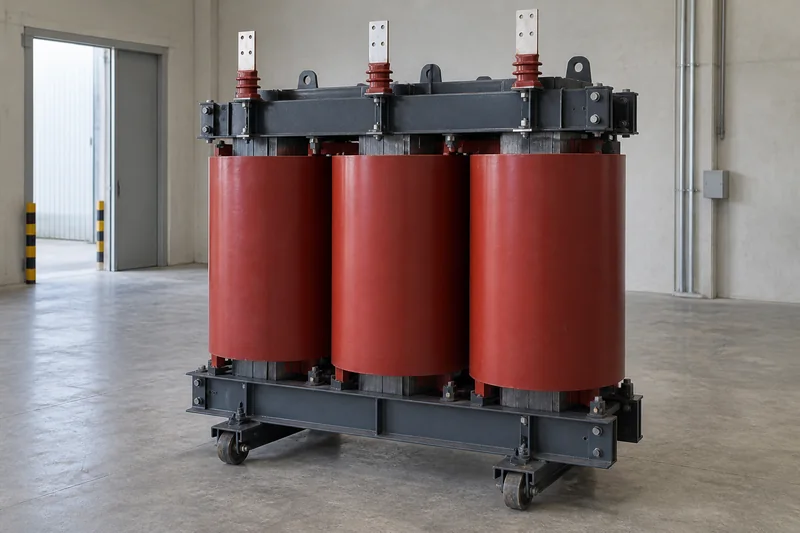
Additional views of 2500 kVA - Reference schedule for quotation. Final outline, terminals and fittings follow the agreed configuration.

Where This Configuration Fits
For an industrial or commercial transformer room, compare the proposed unit with the electrical demand, room space, ventilation and maintenance access. Replacement projects also need the existing nameplate, footprint and cable or busbar interface details.
Hospitals and other critical-load projects need coordinated standby power, switching and protection arrangements. A dry-type transformer alone does not provide uninterrupted power or establish the required system redundancy.


Installation And Operating Conditions
Check these points before fixing the layout or approving the foundation. Final clearances and interfaces come from the configuration-specific outline.
Installation And Interfaces
Review the delivery route, doorway clearance, handling method, floor loading and final maintenance access before confirming the transformer-room layout. Check HV/LV cable or busbar approach and the position of neutral and earthing connections.
Room ventilation and enclosure airflow should be assessed together with the final losses and cooling duty. Do not use a generic minimum clearance or another transformer's dimensions to approve the installation.
Operating Conditions
Provide altitude, ambient temperature range, room ventilation, dust or moisture exposure, expected load profile and significant harmonic-producing equipment. Describe nearby heat sources and any sound limits that apply to the room.
If fans are required, specify the auxiliary supply, temperature monitoring, alarm/trip contacts and interface responsibilities. A fan-assisted rating must be declared for its operating conditions; it is not an unlimited overload allowance.
What The Quotation Covers
Include the required secondary voltage, frequency, quantity, destination and governing project specification. State whether an enclosure, fans, temperature controller and cable or busbar connection accessories are required, and identify equipment supplied by others.
Request the proposed parameter schedule and deviations with the quotation. Agree outline, terminals and monitoring interfaces before manufacture, then define inspection and test records in the order. Public catalogue information does not replace the project-specific technical agreement.
Documents
-
Reference parameter sheet and envelope · Rev. REF-1
Attributed third-party reference values and a simplified bounding envelope. Not a factory-guaranteed datasheet, fabrication drawing or installation approval.
Download
How To Start Your Inquiry
Begin your inquiry with capacity, primary and secondary voltage, frequency, quantity and project destination. Add the electrical specification and room layout when available. If you need selection advice, explain the load and installation constraints rather than selecting an unverified combination.
For EPC review, identify the required technical response, drawing stages and inspection scope. For repeat supply, reference the agreed configuration revision and list any changed site or electrical conditions.
Send the specification you have today. A partial one is fine: the reply lists what still needs confirming before the quotation is comparable.
Request a QuotationBefore You Send The Inquiry
What secondary voltage does this product use?
The 2500/10 designation gives the capacity and primary-voltage basis, but does not by itself specify the secondary voltage. Include the required LV voltage in your inquiry; the final ratio must match your system.
Does adding fans automatically increase capacity by 50%?
No fixed increase should be assumed. Ask for the declared natural-air and fan-assisted ratings, ambient conditions, temperature limits and auxiliary requirements for the offered configuration.
Is an enclosure included?
Define this in the quotation scope. Enclosure protection, dimensions, airflow and terminal access need to match the installation. An image alone does not establish which accessories are included.
What information is needed for a replacement quotation?
Provide the existing nameplate, electrical specification, room or foundation dimensions, handling route and terminal arrangement. Add any changed load, ventilation or monitoring requirements.
Send Your Project Requirements
Share what you know about the project and the reply will follow the parameter schedule above. No configuration selected means you want selection advice, which is fine.
- Rated capacity and voltage ratio
- Frequency, quantity and destination
- Project specification, or the existing nameplate for a replacement
- Site conditions, room or outdoor layout and delivery route